Wednesday, 28 May 2014

Install ANdroid on Windows O.S.

Please follow following links:

https://www.youtube.com/watch?v=Pmg5_KFROQE

Android Architecture

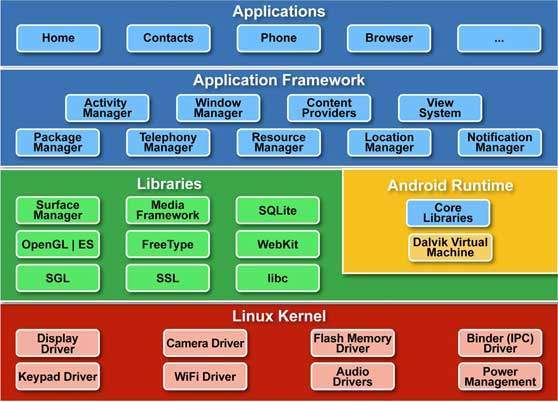
Android operating system is a stack of software components which is roughly divided into five sections and four main layers as shown below in the architecture diagram.
Android Architecture

Linux kernel

At the bottom of the layers is Linux - Linux 2.6 with approximately 115 patches. This provides basic system functionality like process management, memory management, device management like camera, keypad, display etc. Also, the kernel handles all the things that Linux is really good at such as networking and a vast array of device drivers, which take the pain out of interfacing to peripheral hardware.

Libraries

On top of Linux kernel there is a set of libraries including open-source Web browser engine WebKit, well known library libc, SQLite database which is a useful repository for storage and sharing of application data, libraries to play and record audio and video, SSL libraries responsible for Internet security etc.

Android Runtime

This is the third section of the architecture and available on the second layer from the bottom. This section provides a key component called Dalvik Virtual Machine which is a kind of Java Virtual Machine specially designed and optimized for Android.
The Dalvik VM makes use of Linux core features like memory management and multi-threading, which is intrinsic in the Java language. The Dalvik VM enables every Android application to run in its own process, with its own instance of the Dalvik virtual machine.
The Android runtime also provides a set of core libraries which enable Android application developers to write Android applications using standard Java programming language.

Application Framework

The Application Framework layer provides many higher-level services to applications in the form of Java classes. Application developers are allowed to make use of these services in their applications.

Applications

You will find all the Android application at the top layer. You will write your application to be installed on this layer only. Examples of such applications are Contacts Books, Browser, Games etc.

Introduction to Android

What is Android?

Android is an open source and Linux-based Operating System for mobile devices such as smartphones and tablet computers. Android was developed by the Open Handset Alliance, led by Google, and other companies.
Android offers a unified approach to application development for mobile devices which means developers need only develop for Android, and their applications should be able to run on different devices powered by Android.
The first beta version of the Android Software Development Kit (SDK) was released by Google in 2007 where as the first commercial version, Android 1.0, was released in September 2008.
On June 27, 2012, at the Google I/O conference, Google announced the next Android version, 4.1 Jelly Bean. Jelly Bean is an incremental update, with the primary aim of improving the user interface, both in terms of functionality and performance.
The source code for Android is available under free and open source software licenses. Google publishes most of the code under the Apache License version 2.0 and the rest, Linux kernel changes, under the GNU General Public License version 2.

Features of Android

Android is a powerful operating system competing with Apple 4GS and supports great features. Few of them are listed below:
FeatureDescription
Beautiful UIAndroid OS basic screen provides a beautiful and intuitive user interface.
ConnectivityGSM/EDGE, IDEN, CDMA, EV-DO, UMTS, Bluetooth, Wi-Fi, LTE, NFC and WiMAX.
StorageSQLite, a lightweight relational database, is used for data storage purposes.
Media supportH.263, H.264, MPEG-4 SP, AMR, AMR-WB, AAC, HE-AAC, AAC 5.1, MP3, MIDI, Ogg Vorbis, WAV, JPEG, PNG, GIF, and BMP
MessagingSMS and MMS
Web browserBased on the open-source WebKit layout engine, coupled with Chrome's V8 JavaScript engine supporting HTML5 and CSS3.
Multi-touchAndroid has native support for multi-touch which was initially made available in handsets such as the HTC Hero.
Multi-taskingUser can jump from one task to another and same time various application can run simultaneously.
Resizable widgetsWidgets are resizable, so users can expand them to show more content or shrink them to save space
Multi-LanguageSupports single direction and bi-directional text.
GCMGoogle Cloud Messaging (GCM) is a service that lets developers send short message data to their users on Android devices, without needing a proprietary sync solution.
Wi-Fi DirectA technology that lets apps discover and pair directly, over a high-bandwidth peer-to-peer connection.
Android BeamA popular NFC-based technology that lets users instantly share, just by touching two NFC-enabled phones together.

Android Applications

Android applications are usually developed in the Java language using the Android Software Development Kit.
Once developed, Android applications can be packaged easily and sold out either through a store such as Google Play or the Amazon Appstore.
Android powers hundreds of millions of mobile devices in more than 190 countries around the world. It's the largest installed base of any mobile platform and growing fast. Every day more than 1 million new Android devices are activated worldwide.